

The Ash-Years
II. The Ash-Years
History said the protection of the Divine had shrunk, that darkness crept in from the rimlands year on year. In Kaldkloft this looked like small things: a sow farrowing a litter with milk-blank eyes, a priest whose voice went thin when he tried to sing travel hymns over the bridge, ravens gone silent at noon.
Then, rumor arrived on the winter road with a carter: a Redeemer murdered in the south; an Edict drafted in the capital; a prince’s men marching to test both.
When the war reached Kaldkloft it did not come with banners first, but with hunger. Traders stopped. The miller’s boy joined levies. In the silence that followed, strangers began to visit the forge after dark, hands deep in their cloaks.
“We don’t shoe spears,” Einar told them. “We bind what holds a home. We don’t move wards for coin.”
Coins nonetheless clinked on the ashboard. The strangers were polite, then less polite. A week later the kindling pile was soaked with lamp oil and someone had written on the longhouse with pitch: WARDERS FEED WOLVES.
Halvard did not sleep the night the soldiers came. They did not wear the Ashsong colors, or any the boy knew. Their officer half-smiled as he read from a paper with the seal of a lord he’d never met. It punished “builders without sanction.” It claimed the bridge for the crown. It requested the forge be commandeered “in a time of necessity.”
“In a time of necessity,” Einar said, “I fix plows and cook stoves.” He placed his palm on the iron bird above the door. “My vow is to the threshold first.”
The officer shrugged as if it were an old story. “Then your threshold moves.”
They set the rafters alight at dawn.
Halvard remembered few things clearly from that day. The taste of ash. The feel of his mother’s hand pushing his chest. The sound of Einar’s hammer as he smashed a falling beam into a shower of embers that would have eaten the sleeping loft. Bruni Ox-shoe, the carter, shouting from the road with two oxen and a wagon already turning. Lysa Glassreed, barefoot on the snow, dragging a child by the scruff and laughing like a madwoman. Tavi “Quiet,” the runner, appearing where there had been nothing a breath before. The bridge, dark with frost, thrummed under their feet. Halvard turned his head mid-sprint and took one last look through the smoke.
Einar stood in the door—no, inside it, within a square of flame that bent around him like a mouth around a secret. He lifted his hammer to his brow. One blow for stone, one breath for song. He pressed the hammer into Halvard’s chest from halfway across the yard, or so it felt, like a father can do with eyes when he can’t with hands.
“Go,” he mouthed.
They went.
Behind them, Kaldkloft’s longhouse folded like an exhausted animal and lay down in its own fire.
The First Heat
Ashsong
A short novel of Halvard Ashsong, Forgebearer of Kaldkloft
I. The First Heat
Halvard Ashsong took his first breath to the sound of a hammer falling.
The anvil’s voice rolled through the timber bones of the longhouse and into his mother’s hands as she pulled him into the world. Outside, the Kaldkloft birches wore a coat of hoarfrost and the Petra river kept its slow speech beneath a lid of ice. His father, Einar Ashsong, didn’t hear the midwife’s call until the third blow. He set his hammer down on the quench-trough, wiped the salt from his brow, and came inside smelling of iron and ash.
“Strike,” he whispered, laying a rough finger on the boy’s soft chest. “Breathe.” Another touch, over the tiny ribs. “Listen.” He bent his head and the long gray of his beard brushed the child’s cheek. “You came on the right cadence, little coal.”
They named him Halvard, and above the long hearth Einar carved three words into the beam: Strike · Breathe · Listen.
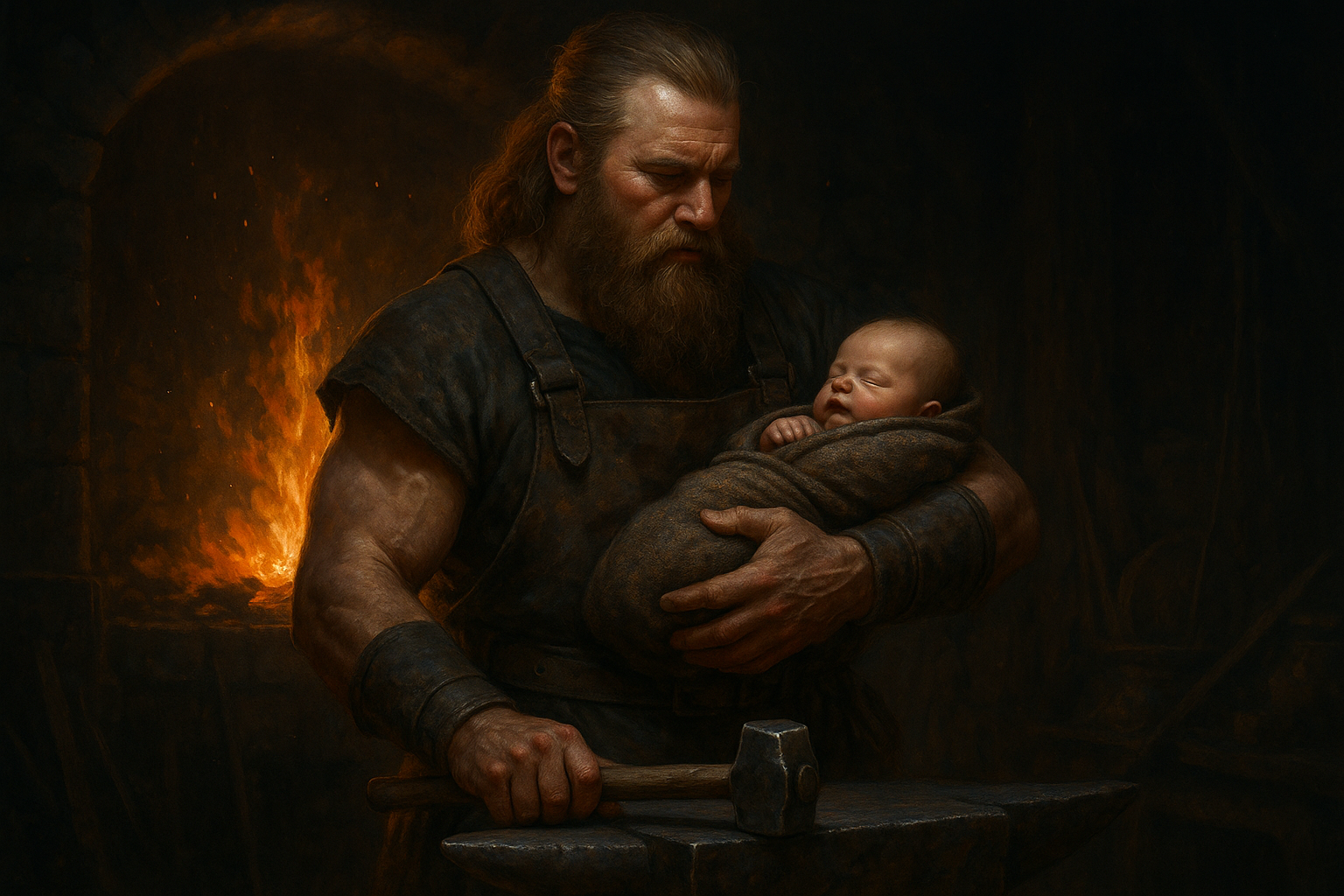
Halvard being carried by his father, Einar
The Ashsong forge was part home, part chapel. Its doors were old oak with feather-stones hammered into the lintel, a pinch of salt under the threshold, a pinch of ash at the corners. On the ridgepole perched a little iron bird the size of a child’s thumb, the clan’s raven-mark. When wind came off the Petra, the iron bird chattered as if telling the roof a secret.
From the beginning, Halvard learned his father’s way: first the blow, then the breath, then the stillness in which a thing revealed what it wished to become. Nails, buckles, hinges, and hoes—all answered if you listened. By twelve, he could shoe a skittish mare without a curse or a welt. By fifteen, he could hear, or believed he could, the shallow hum that ran through the old stone of the bridge as if the river itself sang through it.
“What do you hear?” Einar asked one dusk, while the boy’s ear pressed to the parapet.
“Something like a… drum under the water.”
“That’s the Ley. We don’t command it,” Einar said. “We place signs where it holds. That’s our second vow.”
“The first is to feed,” Halvard recited.
“And the third?”
“To keep the rhythm in craft and in conflict.”
Einar smiled. “Good. Remember pride hides in the third blow. If you strike it for vanity, the world will crack where your mark lies.”
Halvard nodded, filing the words among the other bright things he intended never to forget: his mother’s laugh when geese chased his shoelaces, the clean bell tone of the anvil when the metal was just right, the winter moon caught like a coin on the edge of the Petra’s black ice.
For a while, the world held
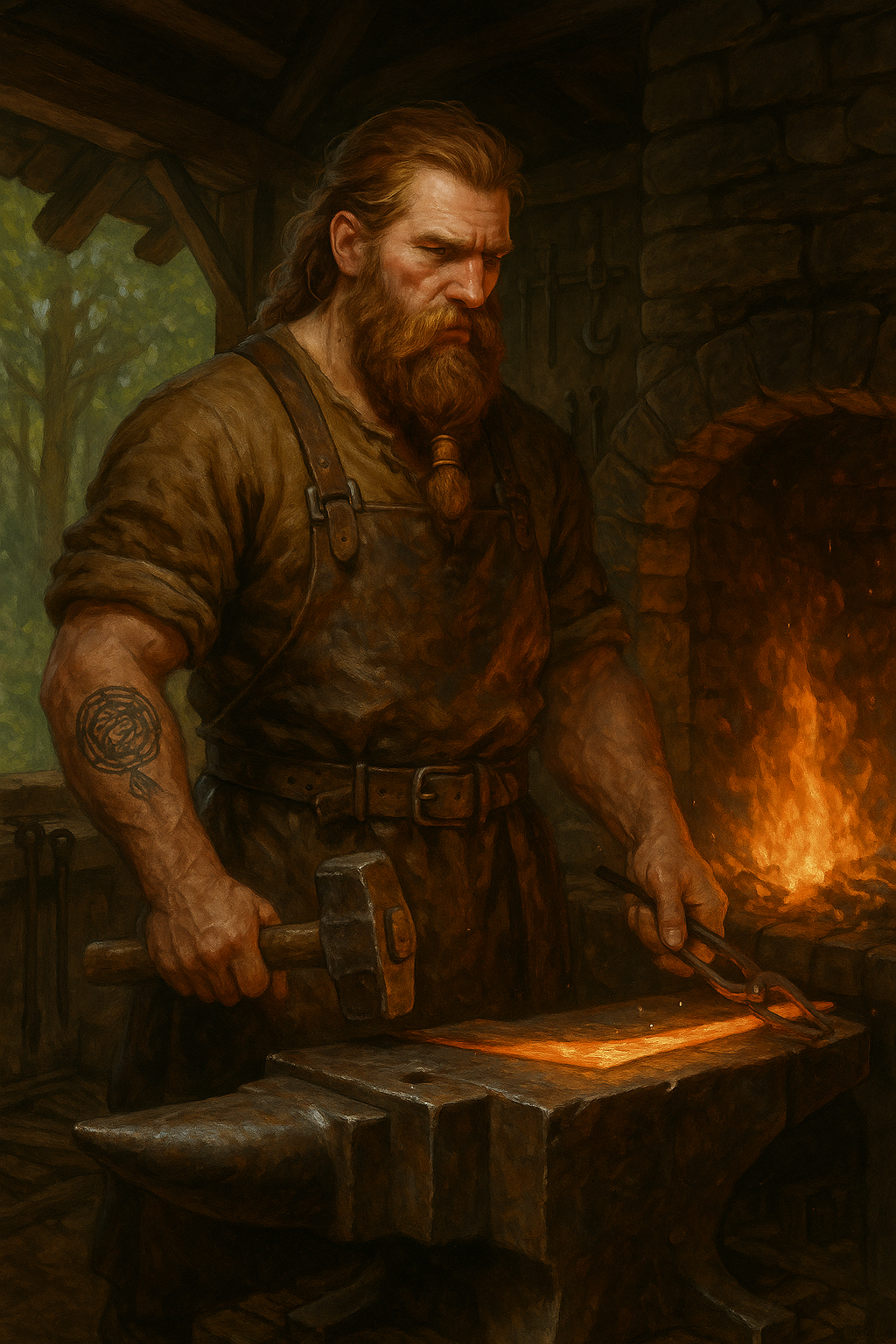
Strike - Breath - Listen